
30 June 2025 · 4 min read
Inside the Bursa factory: practical CNC capacity for European buyers
A closer look at how we use CNC machining capacity in Bursa to support European custom part orders — from single prototypes to repeat production runs.
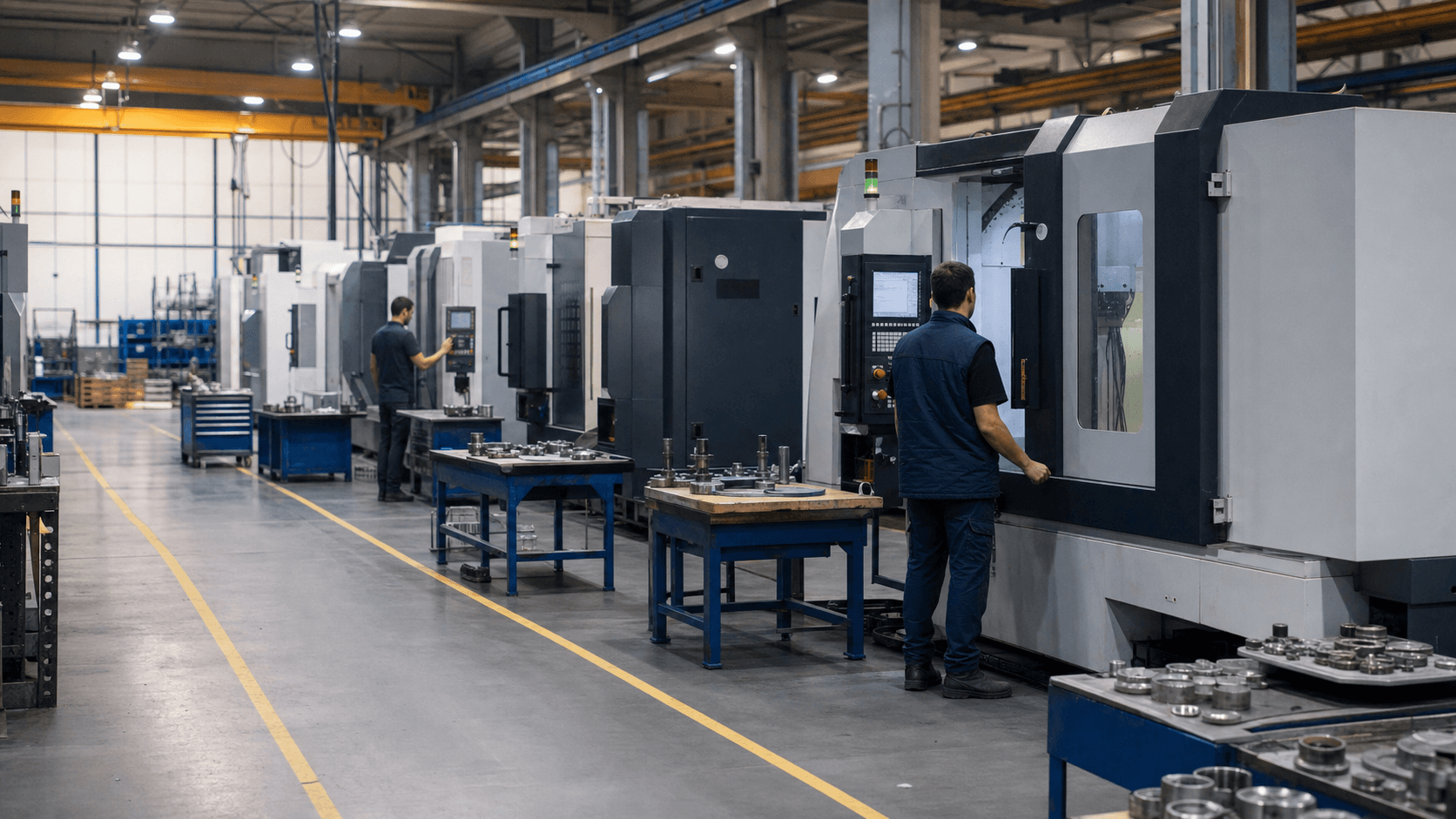
What CNC capacity in Bursa actually means for European buyers
When buyers first hear "manufacturing in Türkiye," there is often a gap between the image they have and the reality of what is available. Bursa has grown into one of the more capable manufacturing centres in the region, with machine shops running multi-axis CNC milling and turning across a range of materials and tolerances. This is not a low-cost assembly operation — it is precision machining with the tooling, measurement equipment, and technical knowledge to match.
The factories we work with are set up for custom part production. That means they are comfortable handling drawings, clarifying specifications before cutting, and delivering against a technical scope rather than just a price list. For European buyers who have been burned by vague quotations and silent suppliers, this distinction matters.
Materials and machining scope
The core material focus is structural steel and aluminium — S235, S355, SS304, SS316 on the steel side, and 6061, 7075, 6082, 5083 on the aluminium side. These cover the majority of what industrial buyers in Benelux and DACH need for components, frames, housings, and precision-fit parts.
On the machining side, the work centres around 3-axis CNC milling and turning. This covers the vast majority of rotational and prismatic parts. For parts that require additional operations — drilling patterns, threading, surface finishing — these can be combined in the same production run rather than outsourced separately.
How production coordination actually works
The practical question buyers have is not "can you make this" but "how do I know it will arrive correctly and on time." The answer comes down to coordination. We sit between the buyer and the production facility, handling the technical translation of drawings into production instructions, managing the schedule, and following up during production rather than only at dispatch.
Lead times for straightforward steel or aluminium parts typically run two to three weeks from confirmed order. For more complex geometries or tighter tolerances, we work out a realistic timeline before confirming — not after the fact.
Why this setup makes sense for repeat orders
Single prototypes are useful for proving a concept. But the real value of this manufacturing setup becomes clear on repeat orders. Once a part is proven — dimensions verified, surface finish confirmed, material certification in hand — repeating that production requires less back-and-forth and a shorter coordination cycle.
Buyers who start with a prototype batch of three to five pieces often move to pilot series within a few months, then to quarterly production once the supply chain is established. That progression is what we design the relationship around from the start.